Methodology
The approach chosen to estimate effective conductivity in a composite structure is based on an accurate calculation of the total thermal resistance between the source and boundaries of the solid at the fluid/solid interfaces. The real structure of the composite is then replaced with a homogeneous structure of similar overall dimensions and boundary conditions, where a value for the conductivity is determined that produces the same solid-body thermal resistance.
The solid-body thermal resistance is the accumulation of thermal resistance encountered between a heat source and the fluid/solid interface. The solid-body thermal resistance can be calculated as:
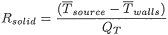
The thermal resistance within the solid consists of two components, the bulk material resistance and the spreading resistance.

The spreading resistance is strongly influenced by the size of the source, the relative position of layers in relation to the source and the convective boundary conditions.
The calculation of spreading resistance mandates that conditions imposed at the boundaries, such as source size and convective conditions be incorporated into the calculation of a solid-body resistance and in turn an effective conductivity. In addition, the source location must be considered for non-concentric applications.
Back to the index